
Search Washington DUI Records
Washington DUI records are public court documents created when someone is charged with driving under the influence in the state. They cover cases from municipal courts, district courts, and superior courts across all 39 counties. You can search Washington DUI records online through several state and county portals, or request copies in person at the courthouse. Each county handles its own records, and the process differs depending on whether the case was a misdemeanor or felony DUI charge. This guide covers the main sources, search tools, and steps you need to find DUI records in Washington.
Washington DUI Records Overview
Where Washington DUI Records Are Kept
DUI cases in Washington go to different courts based on the type of charge. Misdemeanor DUI cases land in district courts and municipal courts. Felony DUI cases go to superior courts. All three court levels create and maintain their own records. There is no single statewide repository that holds every DUI case file.
The Washington Administrative Office of the Courts runs the Washington Courts public case search portal. This tool lets you search for DUI cases by name or case number across multiple court types statewide. It covers superior, district, and municipal courts in most parts of Washington. Search results show party names, case status, hearing dates, and docket entries. The system updates roughly every 24 hours after clerks enter data. It does not display sealed cases and some details may be missing or inaccurate. For complete records or certified copies, contact the court directly after you locate the case.
The portal at dw.courts.wa.gov is the best starting point for most searches. No account is required to use it.
The Washington Courts case search portal gives public access to DUI records from courts across the state, with links to county-level systems for full case documents.
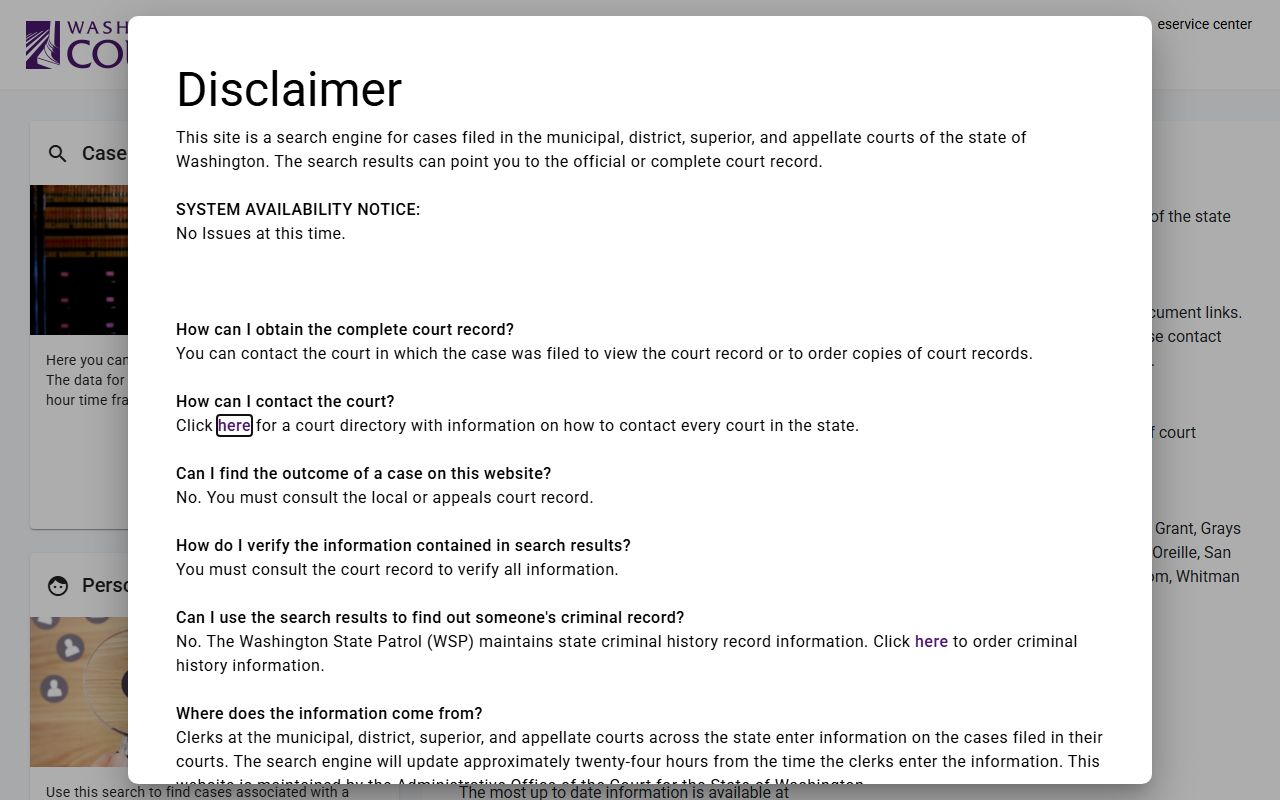
Use the portal to run a name search and pull up DUI case numbers. Those numbers let you request certified copies or full dockets from the clerk in the relevant county.
Thirty-five of Washington's 39 counties use the Odyssey Portal for superior court records. Counties on this system include Adams, Asotin, Benton, Chelan, Clallam, Clark, Columbia, Cowlitz, Douglas, Ferry, Franklin, Garfield, Grant, Grays Harbor, Island, Jefferson, Kitsap, Kittitas, Klickitat, Lewis, Lincoln, Mason, Okanogan, Pacific, Pend Oreille, San Juan, Skagit, Skamania, Snohomish, Spokane, Stevens, Thurston, Wahkiakum, Walla Walla, Whatcom, Whitman, and Yakima. You can search by party name or case number. The portal shows docket entries, case documents, and hearing calendars for public cases. Attorneys can register for e-filing. The public access side is free and needs no login.
The Odyssey Portal covers 35 Washington counties for superior court DUI records, making felony DUI cases searchable in one central system.
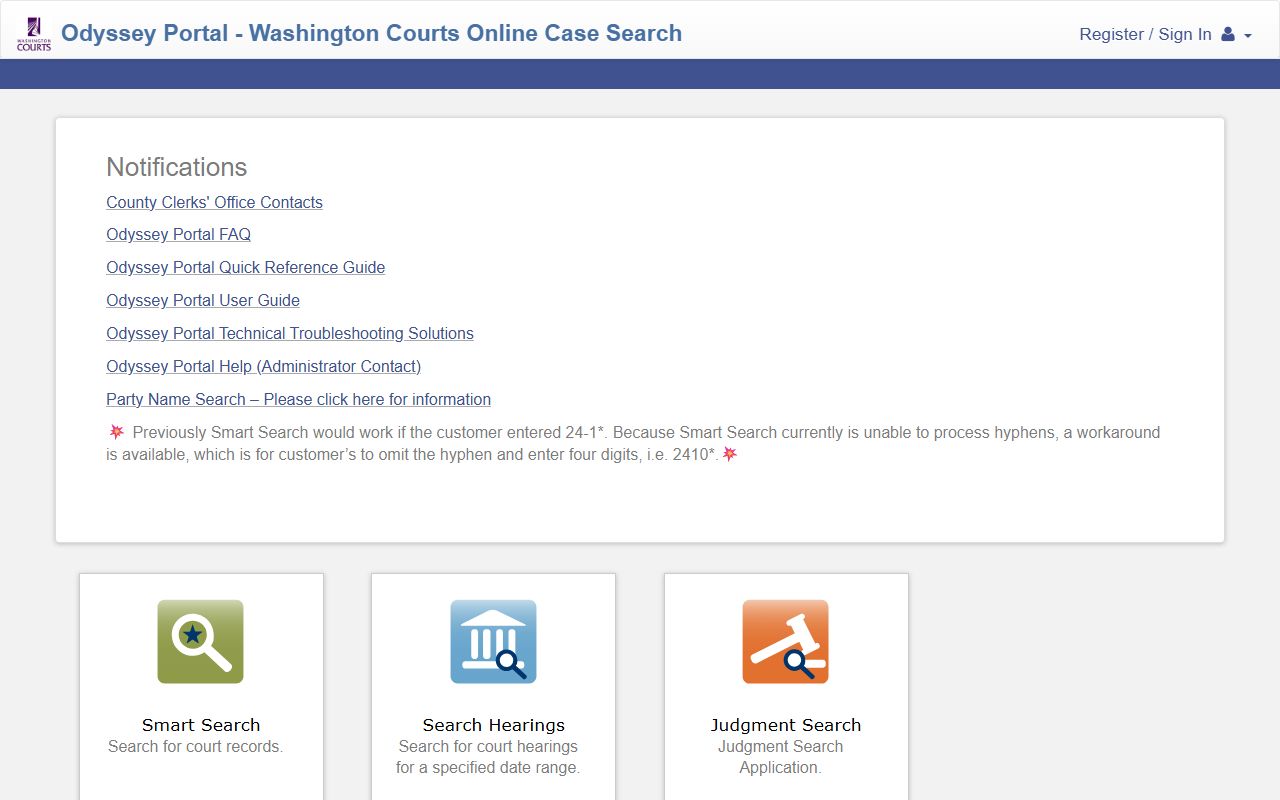
King County uses KC Script at dja-prd-ecexap1.kingcounty.gov for superior court records. Pierce County uses LINX at linxonline.co.pierce.wa.us. Seattle Municipal Court has its own portal at courtrecords.seattle.gov. Spokane Municipal Court uses eCourt at ecourt.spokanecity.org. Asotin and Tacoma also use the Tyler Technologies re:Search system at researchwa.tylerhost.net. Kitsap County District Court runs a separate ePortal at efiling-dc.kitsap.gov. King County District Court uses eCourt at kcdc-efiling.kingcounty.gov.
Note: State court portals show case information but are not official criminal history records. For a formal Washington criminal history report, use the WATCH system run by Washington State Patrol.
What Washington DUI Records Include
A DUI court record in Washington holds a lot more than just the charge. It captures the full life of the case from arrest to final disposition. Misdemeanor DUI records live in district and municipal court files. Felony DUI records sit in superior court case files. Both types are public unless a court has ordered them sealed.
Court records for a Washington DUI case typically include the defendant's name and date of birth, the case number, all charges filed with the RCW citation, the date of the offense and arrest, the arresting agency, chemical test results showing blood alcohol concentration or THC levels, every court hearing date and proceeding, the final disposition such as convicted, dismissed, or deferred, the sentence imposed, jail time and any alternatives ordered like electronic home monitoring, fine amounts, probation terms and conditions, ignition interlock requirements, and any treatment obligations. If the driver refused chemical testing, that refusal also shows up in the case record.
A few things are not in public DUI records. Sealed juvenile cases are not accessible. Convictions that have been vacated under RCW 9.96.060 are removed from public searches, though law enforcement keeps them for future charging purposes. Mental health treatment details linked to a deferred prosecution are not part of the public file.
DOL driving records and court records are two separate things. Courts track the criminal case. The Department of Licensing tracks license status, administrative suspensions, and ignition interlock restrictions. Both may be needed for a complete picture of a person's DUI history in Washington.
Washington DUI records contain these key elements:
- Defendant name, date of birth, and case number
- RCW charge citations and arresting agency
- Chemical test results including BAC or THC levels
- All court dates, docket entries, and proceeding notes
- Final disposition and full sentence details
- Probation terms, fines, and legal financial obligations
- Ignition interlock device orders and treatment requirements
Washington DUI Laws and the Primary Statute
The main DUI law in Washington is RCW 46.61.502. A person violates this statute by driving in Washington with a blood alcohol concentration of 0.08 or higher within two hours of driving, a THC concentration of 5.00 nanograms per milliliter or higher within two hours of driving, or while under the influence of alcohol, cannabis, or any drug. The law covers four separate situations. Each can support a DUI charge on its own, independent of the others.
Most first and second DUI offenses are gross misdemeanors. A person becomes eligible for a felony DUI when they have three or more prior offenses within ten years, giving the charge a class B felony classification. Starting January 1, 2026, that window expands to fifteen years for cases meeting the three-offense threshold. Prior DUI convictions from other states count toward this total. So do convictions for boating under the influence and aircraft operation while impaired, as defined under the penalty statute.
The Washington Courts portal displays the specific RCW citation used in each DUI case. That citation will appear as RCW 46.61.502 or a local city ordinance equivalent in the case record.
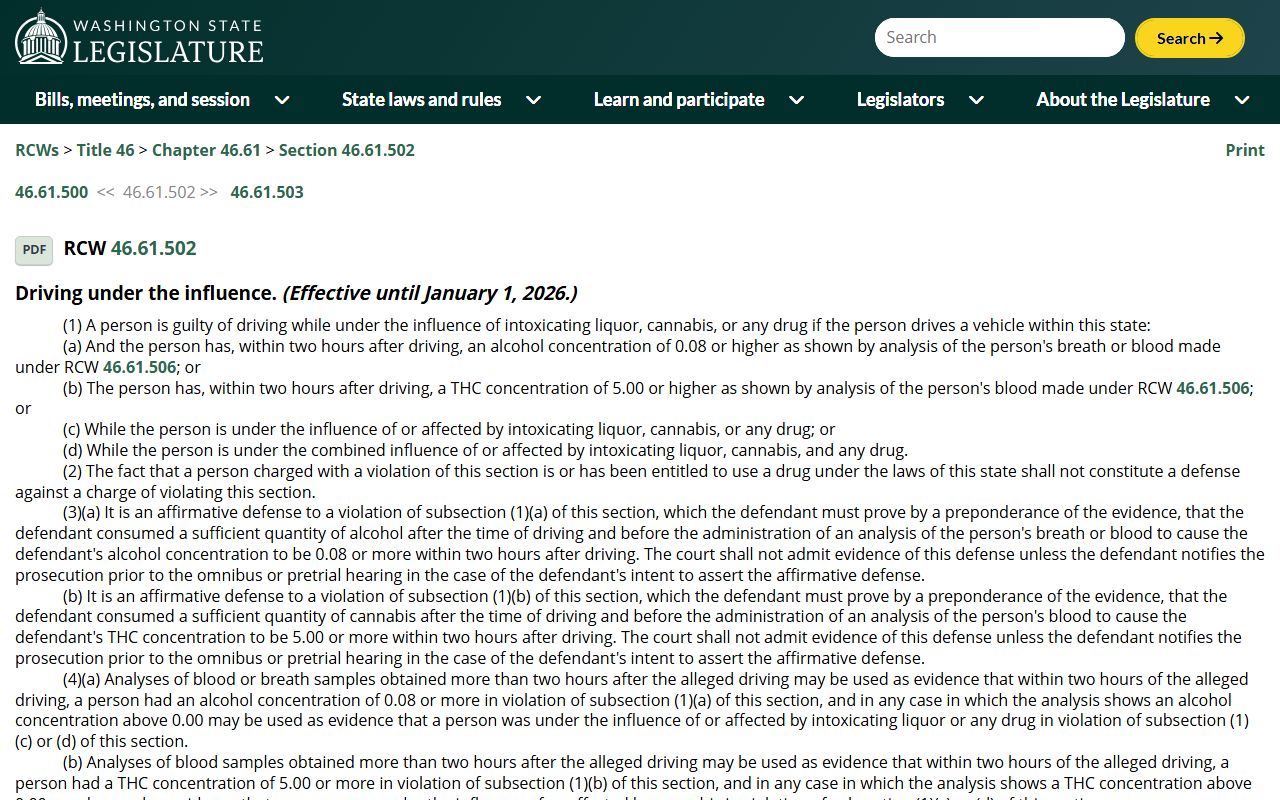
RCW 46.61.502 sets out all four ways a driver can be charged with DUI in Washington, from specific BAC thresholds to general impairment by any substance.
Penalties for DUI in Washington come from RCW 46.61.5055. The first offense with a BAC under 0.15 carries a mandatory minimum of 24 consecutive hours in jail and a fine of at least $350. If the BAC is 0.15 or higher, or if the driver refused testing, the minimum jail time rises to 48 hours and the minimum fine to $500. Courts can order electronic home monitoring in place of the mandatory jail minimum. The second offense escalates to 30 days minimum jail time paired with 60 days of mandatory electronic home monitoring. Fines and monitoring requirements keep climbing with each additional offense within the seven-year window.
Enhanced penalties kick in when a minor was in the vehicle. If a passenger under age 16 was present, the court adds extra jail time, additional fines per passenger, and extended ignition interlock periods. These enhancements appear in the court record as separate written findings. Courts may not suspend or convert these additions.
RCW 46.61.5055 sets the minimum jail time, fine ranges, and monitoring requirements for each DUI offense level in Washington.
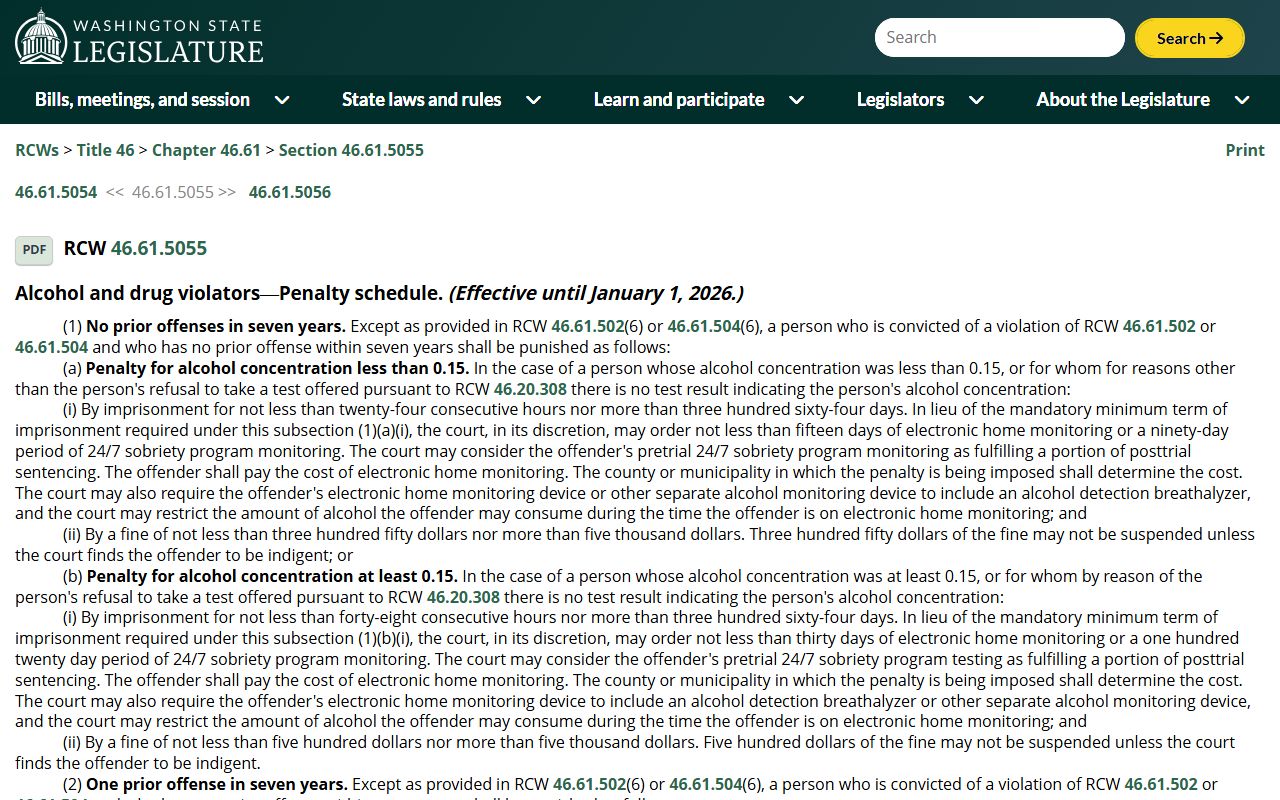
The penalty schedule is one of the most detailed statutes in the Washington DUI system, spelling out jail minimums, fine ranges, and ignition interlock durations for each offense level, including escalating consequences for repeat offenders.
Physical Control and Under-21 DUI Records
Washington has a related offense called physical control of a vehicle while impaired, governed by RCW 46.61.504. A driver does not have to be operating the vehicle to face this charge. Sitting in the driver's seat with keys, sleeping in a parked car while impaired, or having actual physical control of the vehicle in any way can trigger it. The BAC and THC thresholds are identical to standard DUI. Penalties are the same too.
One key difference from a standard DUI is the safe harbor defense. If the driver realized they were impaired and moved the vehicle safely off the road before any police contact, they cannot be convicted under this section. That defense is not available for a standard driving DUI charge. Physical control records show up in the same court systems and appear in the same searches as regular DUI records. The two charges are sometimes filed together when the facts support it.
RCW 46.61.504 covers physical control of a vehicle while impaired. It carries the same penalties as DUI but includes a safe harbor defense for drivers who parked safely before police made contact.
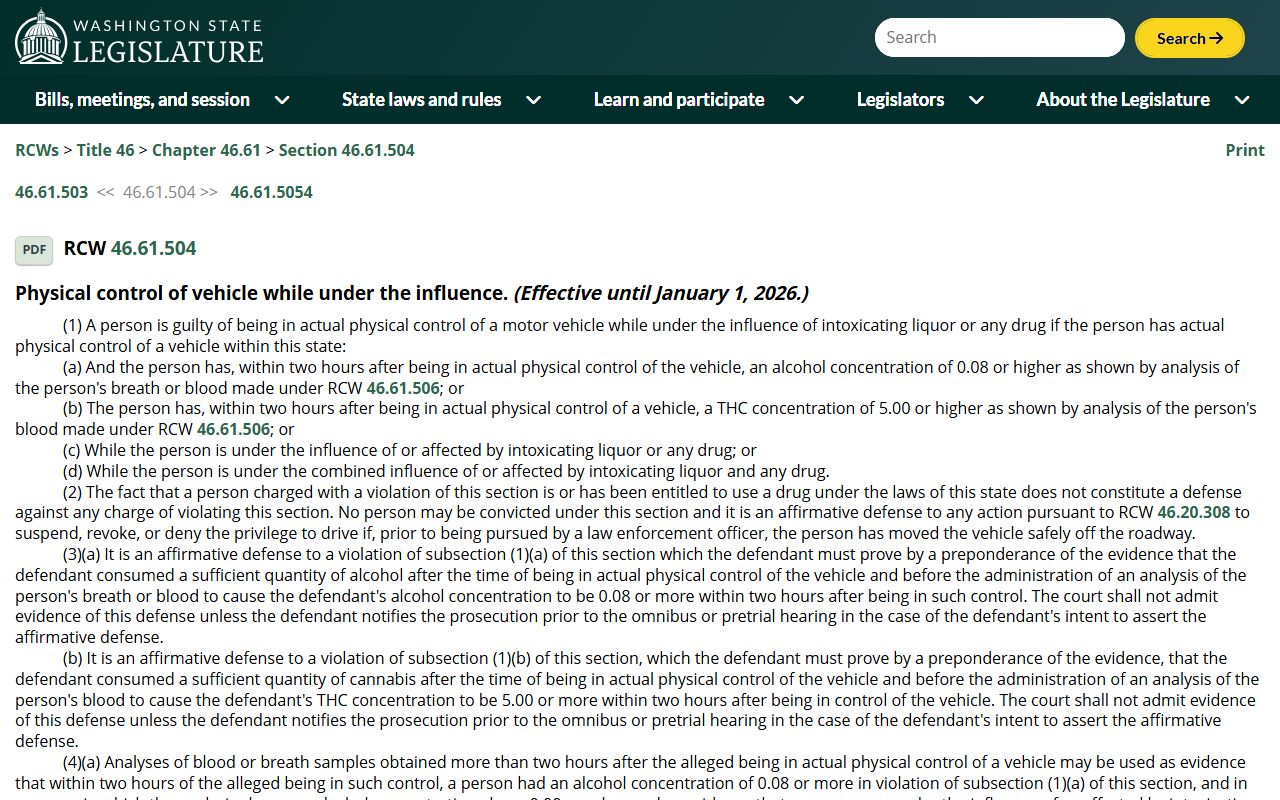
Physical control charges appear in the same court record search systems as DUI cases, and they count as prior offenses under the same seven-year and ten-year lookback rules.
Washington uses a zero tolerance policy for drivers under 21 through RCW 46.61.503. An underage driver commits a violation with a BAC of at least 0.02 but less than 0.08 within two hours of driving, or any detectable THC above 0.00 but below 5.00 ng/mL. Both thresholds are far lower than the adult standard. The under-21 charge is a misdemeanor rather than a gross misdemeanor. The Department of Licensing takes separate administrative action on the driver's license even if the criminal charge is later reduced or dismissed.
Under-21 DUI records in Washington involve both a court criminal case file and a separate DOL administrative record. Both can be searched independently through their respective systems.
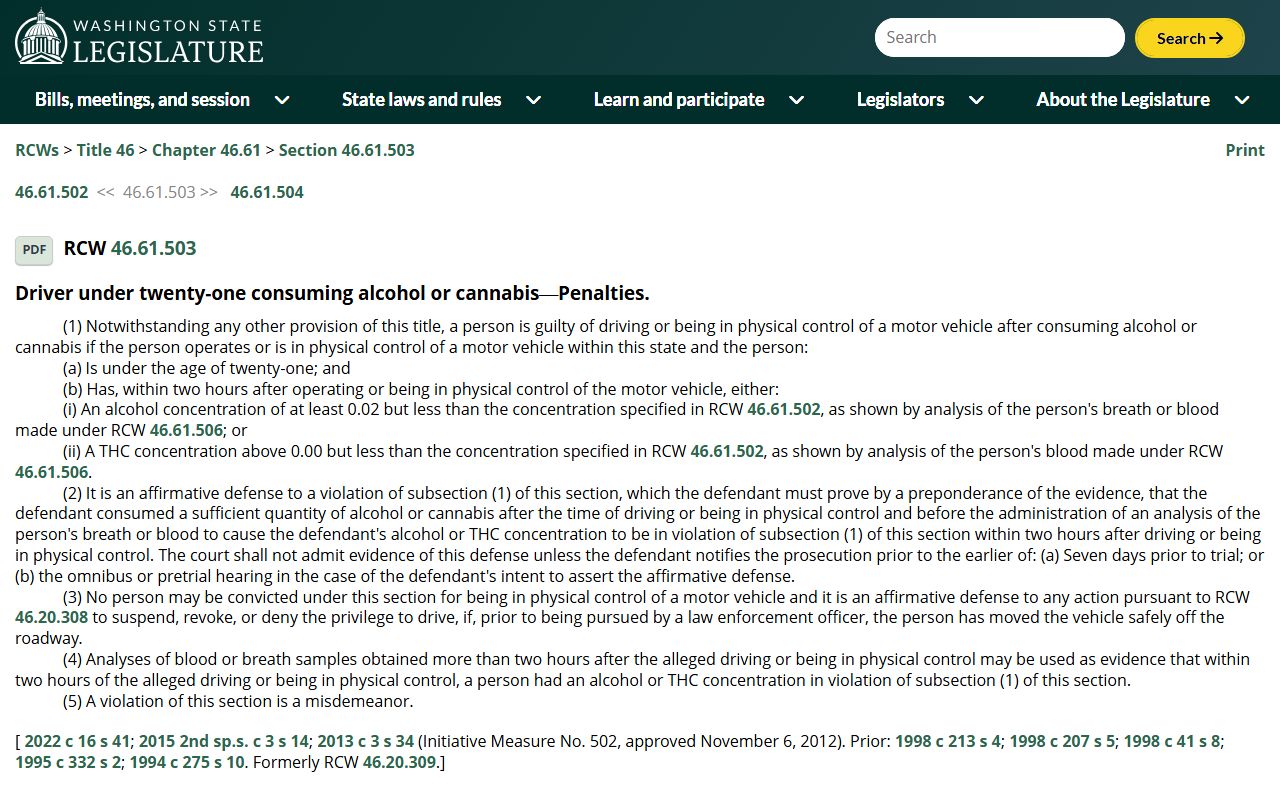
RCW 46.61.503 applies to drivers under 21 with any detectable BAC of 0.02 or higher, making Washington's zero tolerance policy one of the broadest DUI enforcement tools in the state's legal framework.
Implied Consent, Testing, and DUI Case Records
Washington's implied consent law is in RCW 46.20.308. Every driver operating a vehicle in Washington is considered to have given consent to a breath test. When someone is arrested for a DUI-related offense, the officer must tell them about the right to refuse, that refusal leads to a license revocation of at least one year, and that they can have an independent blood test done by a qualified person of their choice. If the driver agrees and the test shows 0.08 or higher, or if they refuse, the officer serves written notice and notifies DOL.
Drivers who want to fight the administrative license suspension have seven days from the arrest date to request a hearing from DOL. The hearing fee is $375, though indigent persons can have it waived. Hearings happen by phone or in person and must take place in the county of arrest within 30 days. If the suspension is upheld, the driver can file a petition in superior court within another 30 days, but filing that appeal does not pause the suspension.
The implied consent law creates a DOL administrative proceeding that runs parallel to the criminal court case. Both proceedings generate separate records that can be searched through different systems.
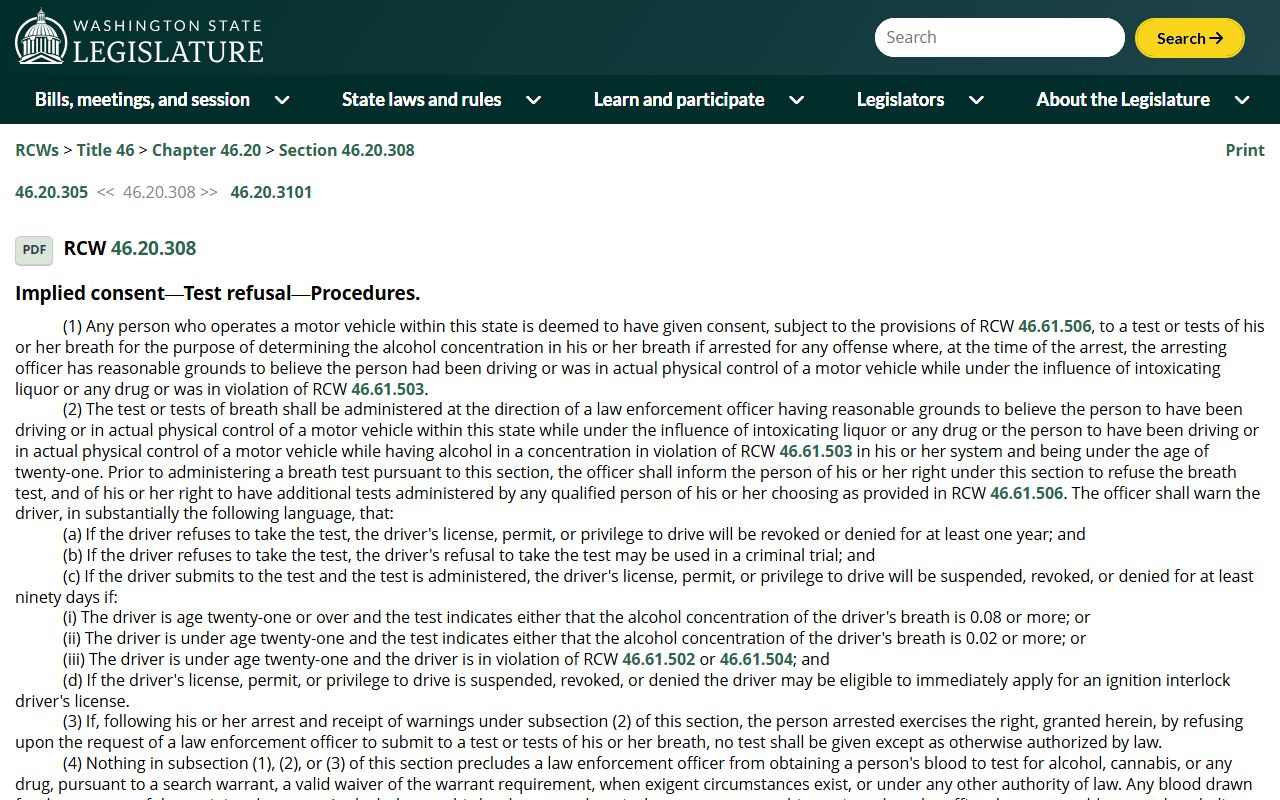
RCW 46.20.308 establishes the breath testing framework, refusal consequences, and the administrative hearing process that runs separately from and alongside the criminal DUI case.
How breath and blood tests are performed matters in DUI records because test validity is often challenged. RCW 46.61.506 sets eight requirements that must be met for a breath test to be admissible as prima facie evidence. These include confirming the person did not eat, drink, or smoke for at least 15 minutes before the test, that two breath samples agreed within 10 percent of their mean, and that the breath analyzer passed all blank and simulator tests. Blood draws must be performed by a licensed healthcare provider or a certified forensic phlebotomist. Test challenges based on this statute often appear in DUI case dockets as motions to suppress, making the testing records a central part of many case files.
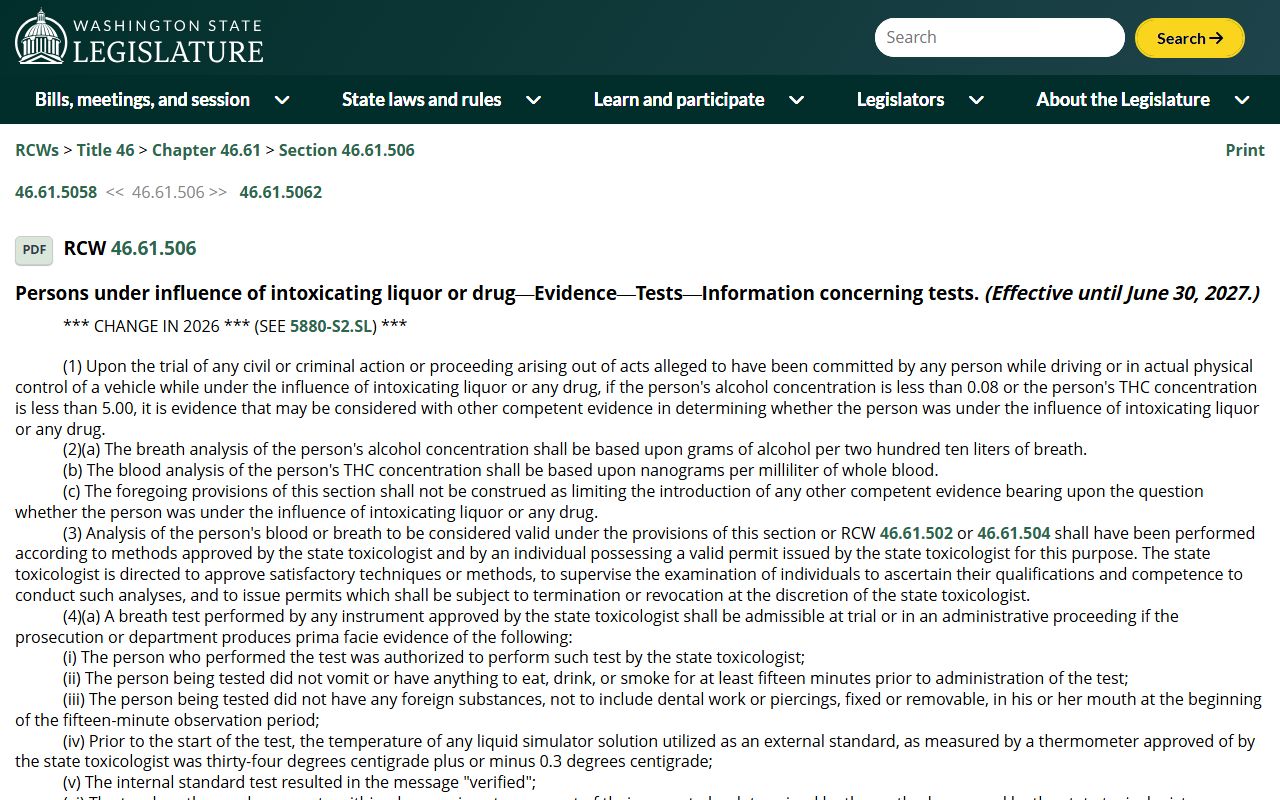
RCW 46.61.506 requires that breath test results meet strict procedural standards before courts can treat them as prima facie evidence in a Washington DUI case.
Under RCW 46.61.517, a driver's refusal to submit to a breath or blood test is admissible as evidence at trial. The jury may consider the refusal as evidence of consciousness of guilt. This makes a refusal a significant part of the DUI case record even when no chemical test results appear in the file.
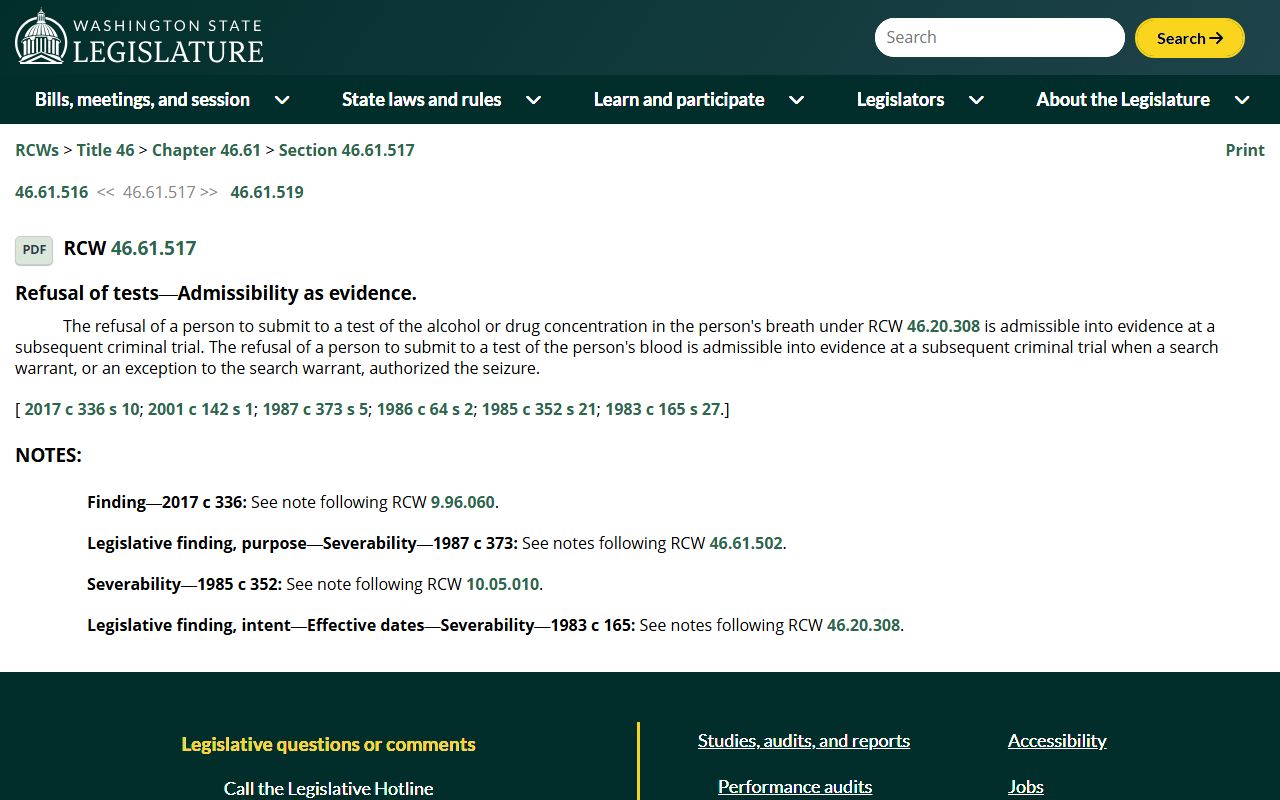
When a refusal appears in a Washington DUI record, it typically signals a one-year or two-year administrative license revocation at DOL tracked separately from the court case.
DUI License Suspension Records in Washington
Washington's Department of Licensing maintains records of license actions resulting from DUI arrests and convictions. These are separate from court records. The DOL DUI suspensions page explains both tracks. Two types of suspension apply: one triggered by the arrest itself and one triggered by a court conviction.
The arrest-based administrative suspension begins 30 days after the arrest date unless the driver requested a hearing and won. The conviction-based suspension begins 45 days after DOL gets notice from the court. DOL gives day-for-day credit for time already served under the administrative suspension, so the total license loss period does not simply double. Suspension lengths vary based on the number of prior offenses and whether the driver tested above 0.15 or refused testing. During any suspension period, a driver may be eligible for an Ignition Interlock Driver License, which allows driving with a device installed. SR-22 insurance is also required.
The DOL DUI suspensions page explains the administrative and conviction-based suspension tracks and how to apply for an ignition interlock driver license during the suspension window.
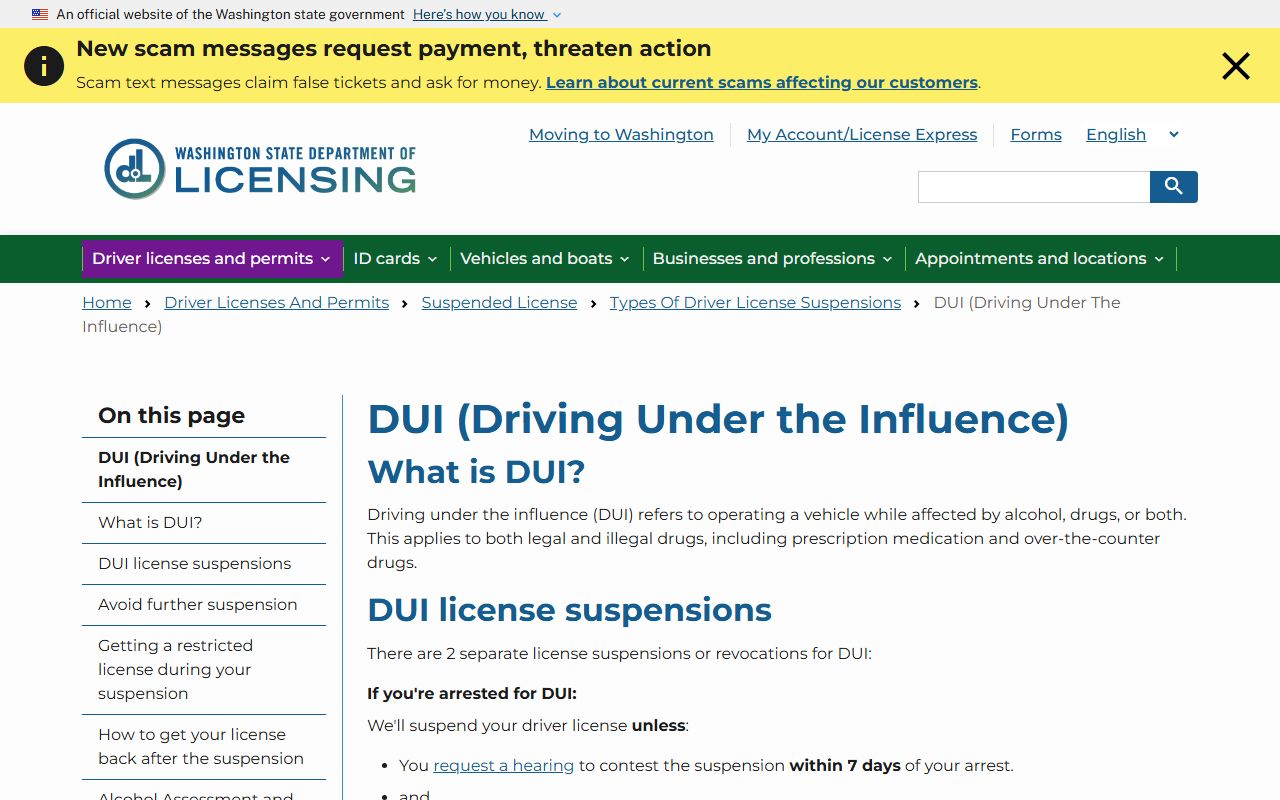
DOL records show license status and suspension history but not the court case file. Both sources together give the most complete view of a person's DUI history in Washington.
RCW 46.20.3101 sets the specific administrative suspension periods. A first refusal within seven years with no prior administrative action leads to a one-year revocation. A second refusal or a first refusal with a prior action results in a two-year revocation. For drivers who took the test and registered a violation, a first incident within seven years brings a 90-day suspension. A second or later incident brings a two-year revocation. These time windows also apply to drivers under 21 at the lower BAC thresholds under that statute.
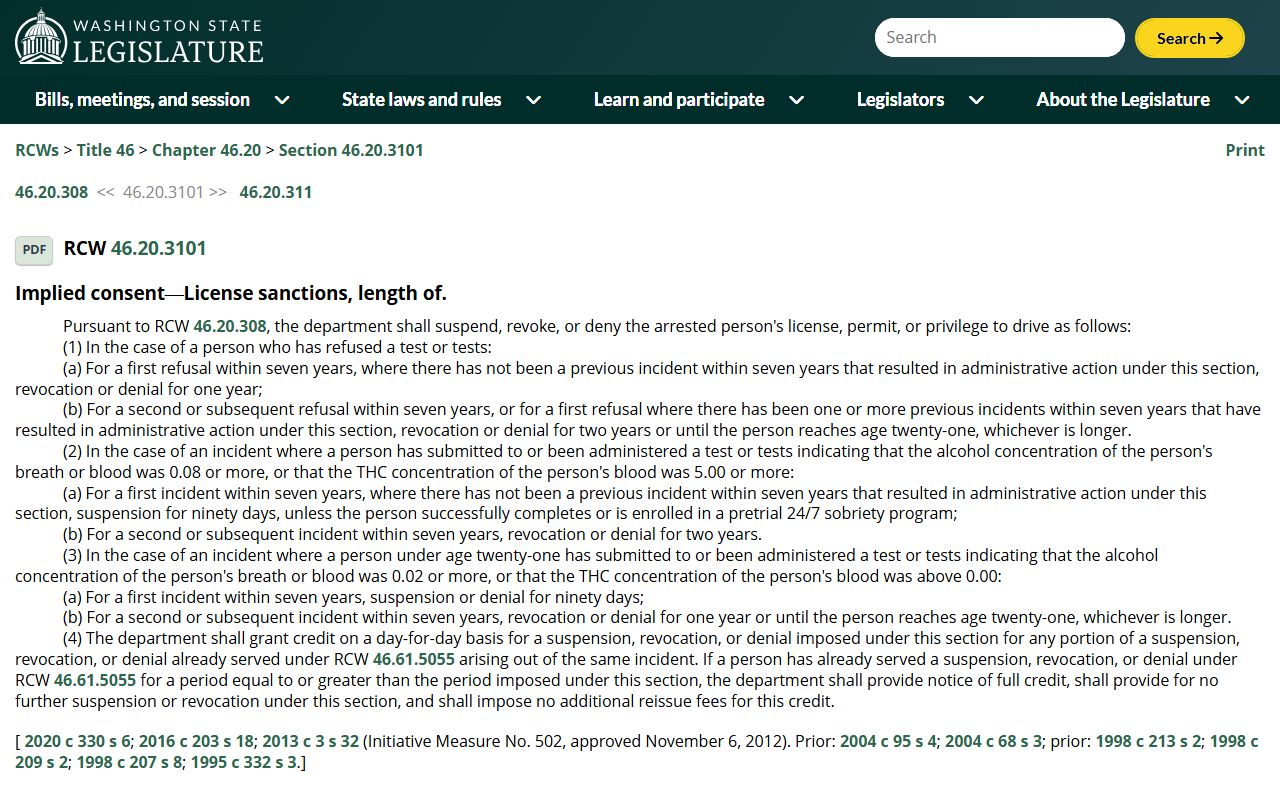
Administrative license suspension records from DOL require a separate search through DOL's own systems. They do not appear in the court record portals used to search DUI case files.
After a suspension ends, most DUI convicts must install an ignition interlock device before DOL reinstates their license. RCW 46.20.720 governs the requirement. A first DUI restriction requires the device for at least one year. A second restriction period is at least five years. A third or later restriction runs at least ten years. The device must prevent the car from starting if the breath sample shows 0.020 or more alcohol. The vendor must certify 180 consecutive days without violations before DOL will authorize removal. A $21 monthly fee applies for the device, remitted to the state's ignition interlock revolving account.
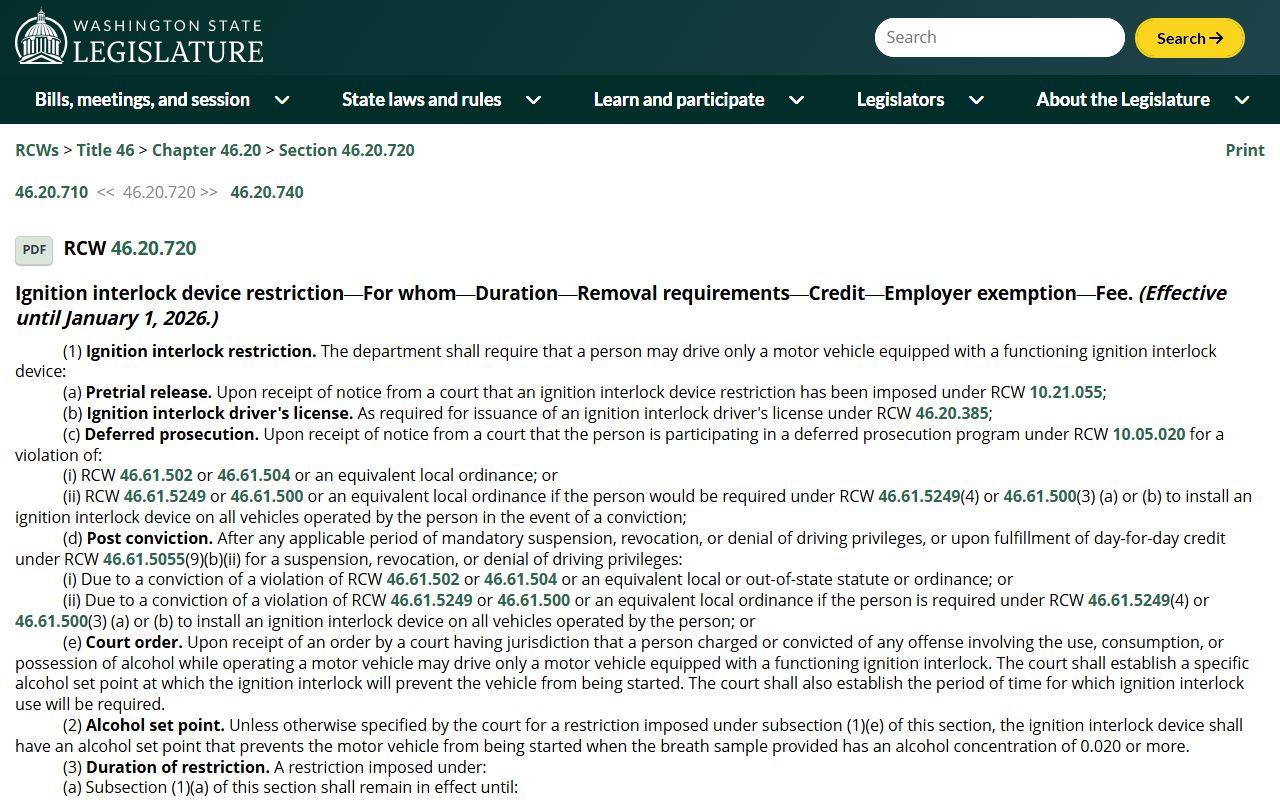
Ignition interlock requirements under RCW 46.20.720 appear on the DOL driving record as a restriction notation, tracked separately from the court DUI case records.
Deferred Prosecution and Vacation of Washington DUI Records
Washington allows some DUI defendants to seek deferred prosecution under RCW 10.05.010. Under this option, the court holds off on finding the defendant guilty and places them in a two-year treatment program. If the person completes the program and meets all conditions, the charge is dismissed. Deferred prosecution is only available in courts of limited jurisdiction, not superior courts. Before January 1, 2026, a person could only receive one deferred prosecution for Title 46 RCW offenses in their lifetime. Starting January 1, 2026, a second deferred prosecution may be available for a subsequent offense if the person has no prior convictions that count as prior offenses under the penalty schedule and the first deferred prosecution was successfully completed.
Deferred prosecution records are not automatically sealed. During the deferral period, the case appears in court records as pending or deferred. License suspension may be stayed during the consideration period but only up to 150 days after charges are filed or two years after arrest, whichever comes first.
The deferred prosecution statute at RCW 10.05.010 is one of the few paths in Washington where a DUI charge can avoid a conviction record if all treatment conditions are met over two years.
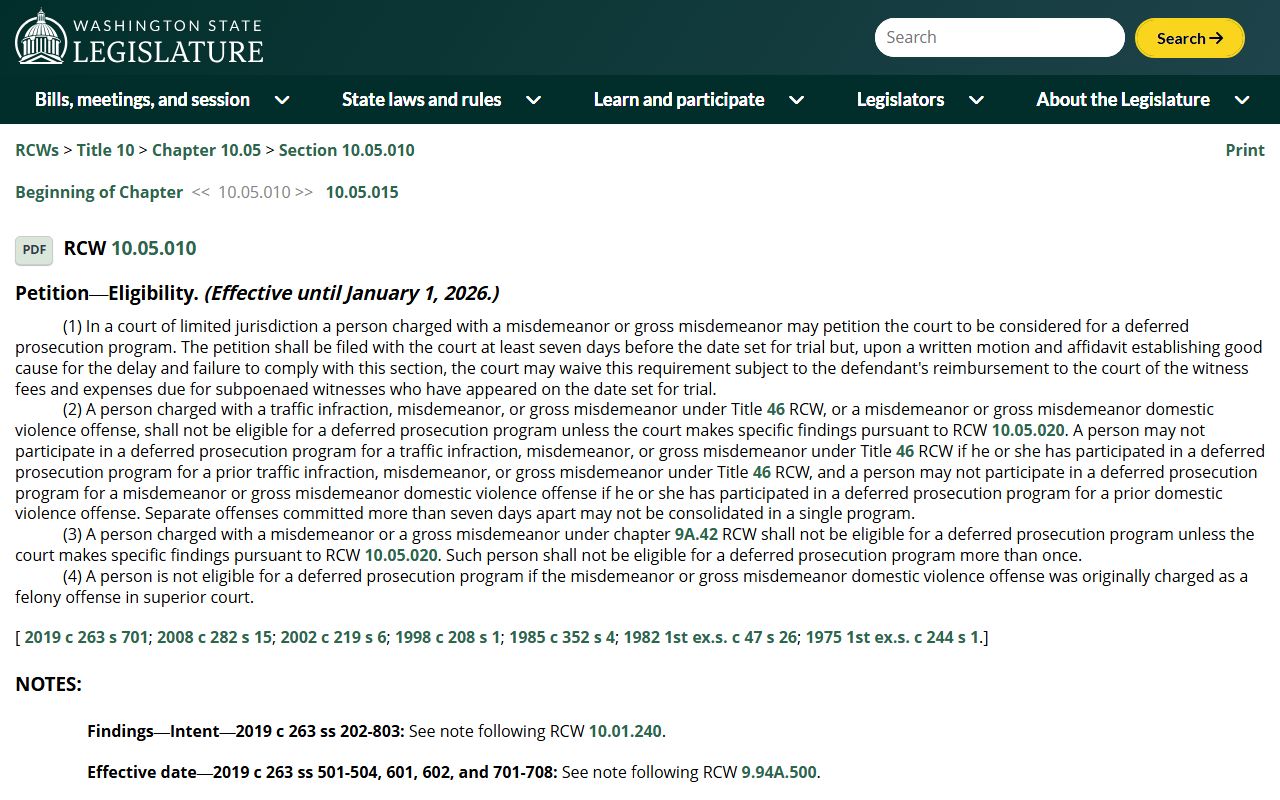
A deferred prosecution that ends in dismissal still shows as a filed case in court records, even though no conviction appears in the final disposition entry.
Most DUI convictions in Washington cannot be vacated. RCW 9.96.060 explicitly bars vacation of DUI convictions if the offense qualifies as a prior offense under the penalty schedule and either a subsequent alcohol or drug violation occurred within ten years of the arrest date, or less than ten years has passed since the arrest date. Since most people seeking vacation have at least one prior DUI record, the ten-year rule makes most Washington DUI records effectively permanent. Law enforcement agencies keep the record even after vacation for future charging decisions.
Even when a DUI record is vacated, the DOL driving record retains the history indefinitely. Vacation removes the conviction from public court searches but does not clear the DOL record or law enforcement databases.
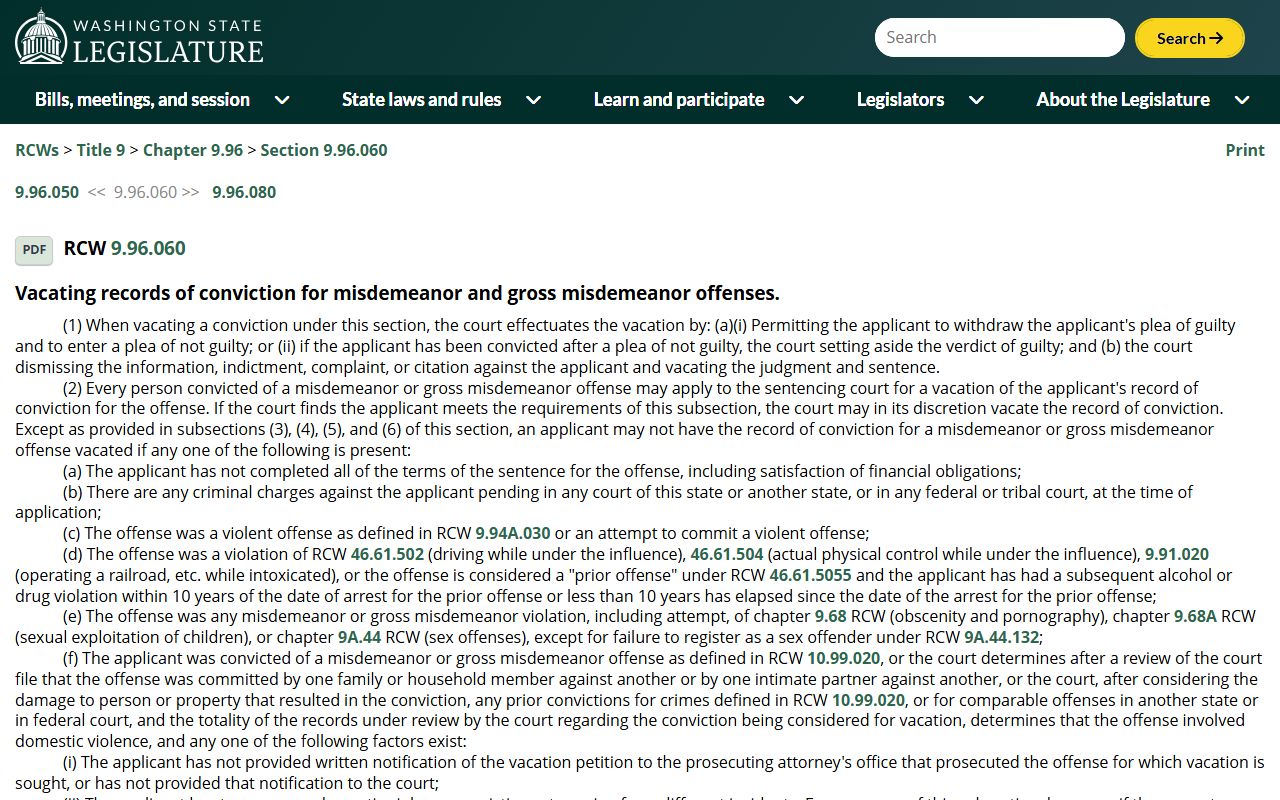
RCW 9.96.060's strict limitations on DUI vacation mean that the vast majority of Washington DUI records remain accessible through court search portals for the long term.
WATCH System and DUI Criminal History in Washington
The Washington Access to Criminal History system, known as WATCH, is run by Washington State Patrol. It provides official criminal history reports that include DUI convictions. A name and date of birth search costs $10. The report covers Washington state convictions, arrests less than 12 months old without a final disposition, registered sex and kidnapping offender status, and corrections information. Unlike the court case portals, WATCH is built for criminal history record information rather than case-by-case lookups. A new system called PIIES 2.0 is being launched to replace the current WATCH interface; the notary fee will rise to $15 when that transition completes.
WATCH includes DUI and physical control convictions. It does not cover federal convictions, out-of-state convictions, sealed cases, vacated records, or juvenile records. If you need to confirm whether someone has a DUI conviction in Washington, a WATCH search returns a formal record rather than just case information pulled from a court portal.
The WATCH system at Washington State Patrol provides official Washington criminal history, including DUI convictions, for a $10 search fee.
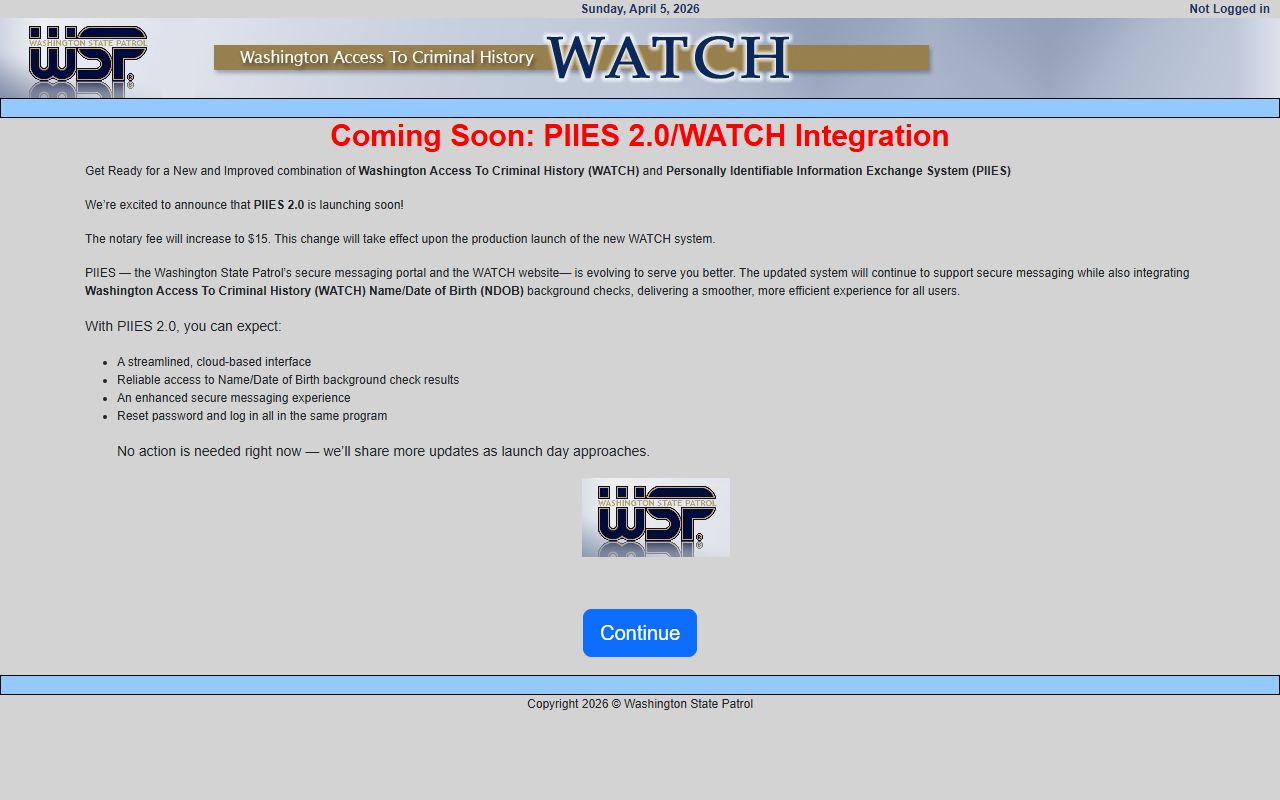
WATCH is the correct tool when you need a verified criminal history record for Washington rather than general case information from a court search portal.
Before sentencing a DUI defendant or allowing a deferred prosecution or dismissal, both the court and prosecutor must verify the defendant's full criminal history and driving record under RCW 46.61.513. This covers all prior DUI-related convictions and deferred prosecutions. Courts using the Judicial Information System must pull current records within one working day. Courts not on JIS have up to seven calendar days. The verification findings must appear as specific written findings in the sentencing order. This process directly affects whether the current charge is treated as a first, second, third, or felony-level DUI.
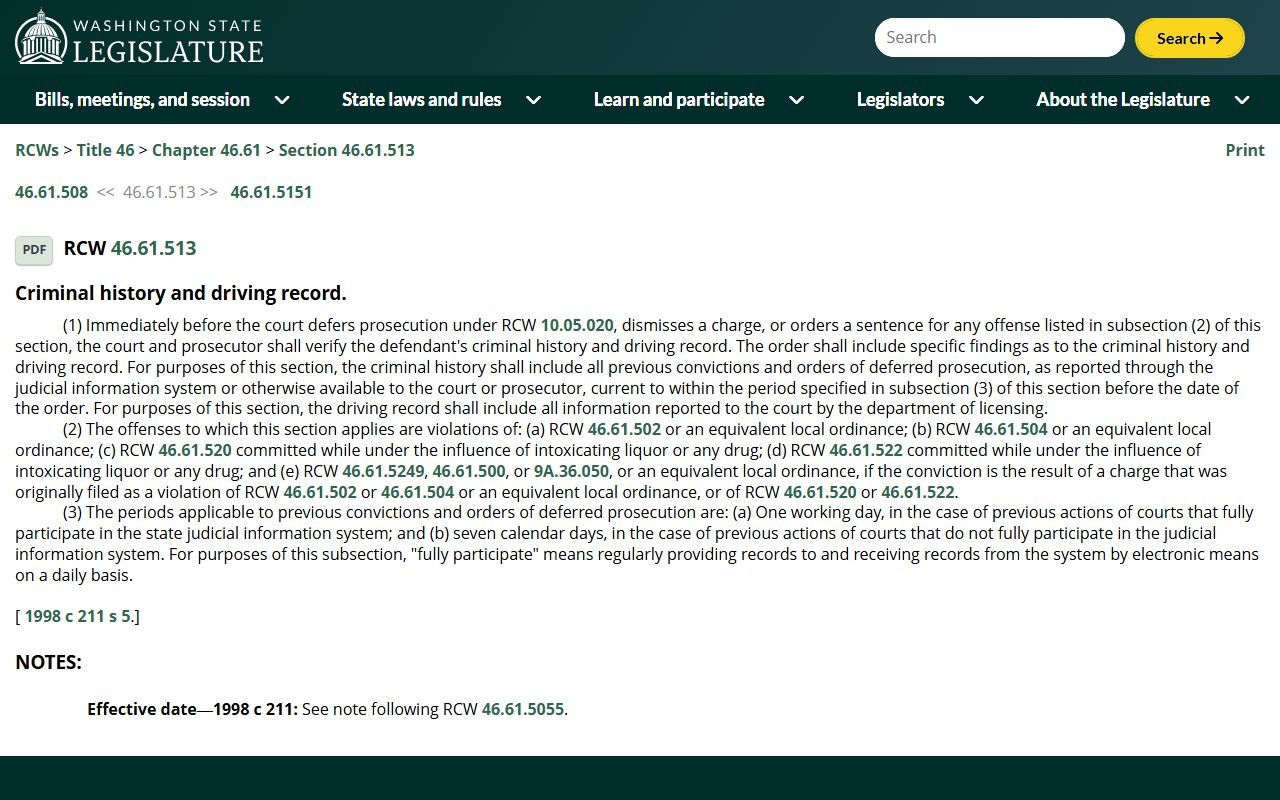
RCW 46.61.513 ensures that every Washington DUI sentencing is based on a current and verified record of the defendant's full prior history, directly shaping the charge level and sentence range imposed.
Court Forms and Legal Help for Washington DUI Cases
The Washington Courts website has official forms related to DUI cases at courts.wa.gov/forms. These include deferred prosecution petition forms, misdemeanor judgment and sentencing forms, guilty plea forms, certificates of discharge, and forms for vacating or sealing records. The Guide and File tool walks you through interactive interviews that produce completed forms based on your answers. Local courts may have additional forms required by their own local rules. Always check the specific court's website for local form requirements before filing anything.
Washington state court forms for DUI cases are available free through courts.wa.gov, including deferred prosecution petitions and record vacation forms.
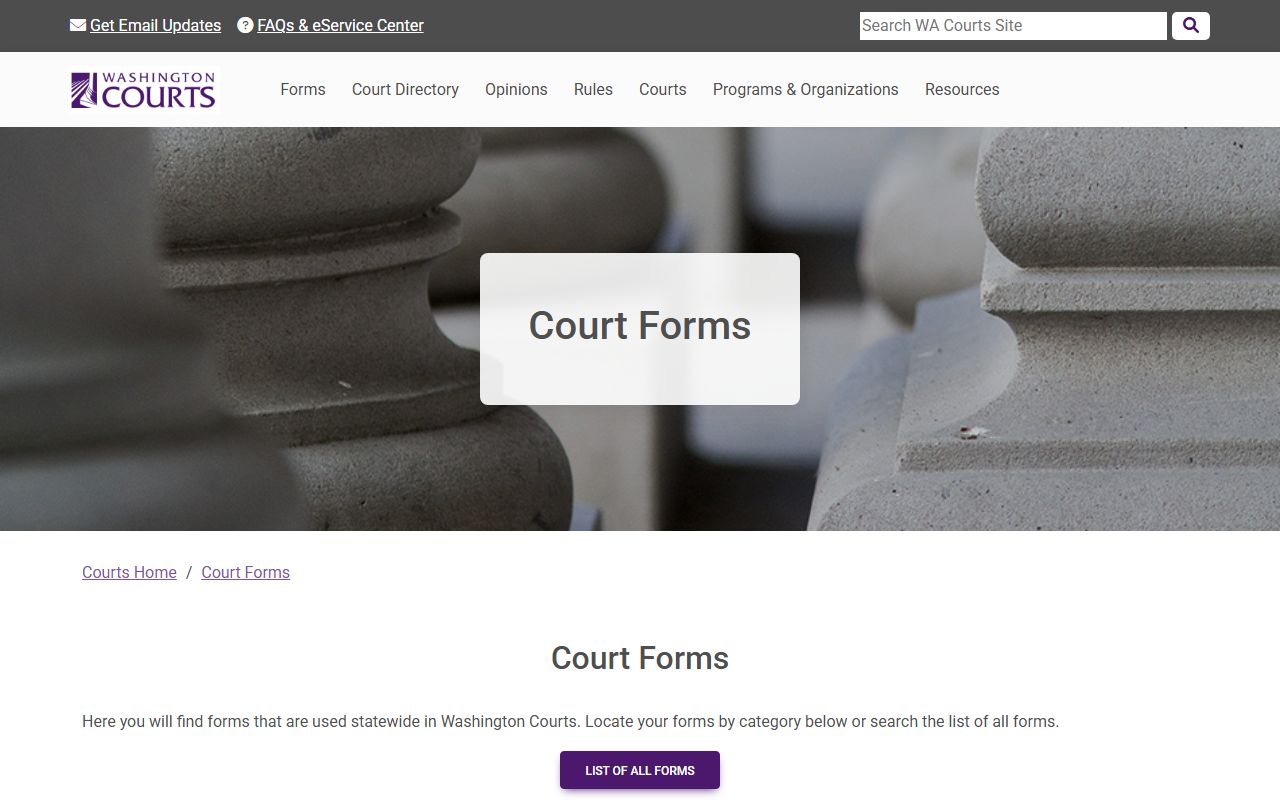
The Washington Courts forms page provides both PDF downloads and an interactive Guide and File tool that helps people complete forms correctly for their specific DUI-related situation.
Washington LawHelp is a free legal information library run by Northwest Justice Project. It has guides on DUI topics including what to expect in court, how deferred prosecution works, and how to request records through official state systems. Northwest Justice Project also provides free legal help to low-income residents. Call 888-201-1014 to ask about DUI-related legal assistance. The Washington State Bar Association runs a lawyer referral service at (206) 443-9722 for those who need an attorney rather than self-help resources.
Washington LawHelp at washingtonlawhelp.org offers free DUI guidance, self-help tools, and links to legal aid programs across the state.
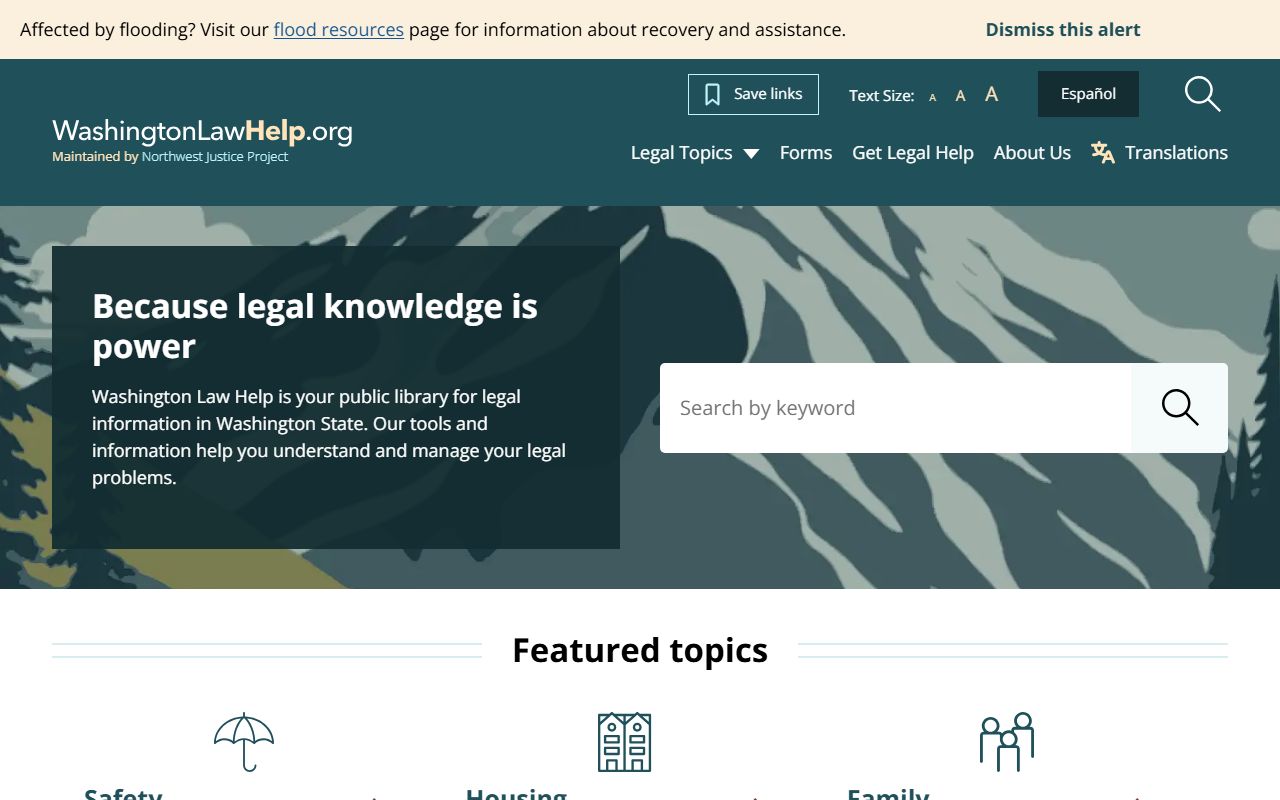
Washington LawHelp connects people with legal information, self-help tools, and local legal aid organizations throughout Washington for DUI and other legal matters.
Browse Washington DUI Records by County
Each of Washington's 39 counties handles its own DUI records through local courts. Pick a county below to find the court system, search portals, and records request process for DUI cases in that area.
View All 39 Washington Counties
DUI Records in Major Washington Cities
Larger cities in Washington often have their own municipal courts handling misdemeanor DUI cases within city limits. Pick a city below to find the right court for DUI records in that area.